People ask this more often than you’d think: can yoga actually make you stronger, or is it just stretching with better marketing? The honest answer is that it depends on what you mean by strength. If your goal is to add visible muscle mass, lifting weights will get you there faster — you can load a barbell far beyond your bodyweight, and progressive overload is what drives hypertrophy. Yoga works differently. It’s a bodyweight practice, so the resistance you’re working against is capped at, well, you. But within that limit, a well-chosen set of poses builds real, functional strength — through the shoulders, the core, the legs, the whole postural chain — and it does it while also improving balance, flexibility and control in a way a barbell won’t.
So yes, yoga can build strength. How much depends entirely on which poses you practise and how consistently. Here are nine that reliably show up in a strength-focused practice, along with what each one is actually doing to your body and how to get into it safely.
1. Plank Pose
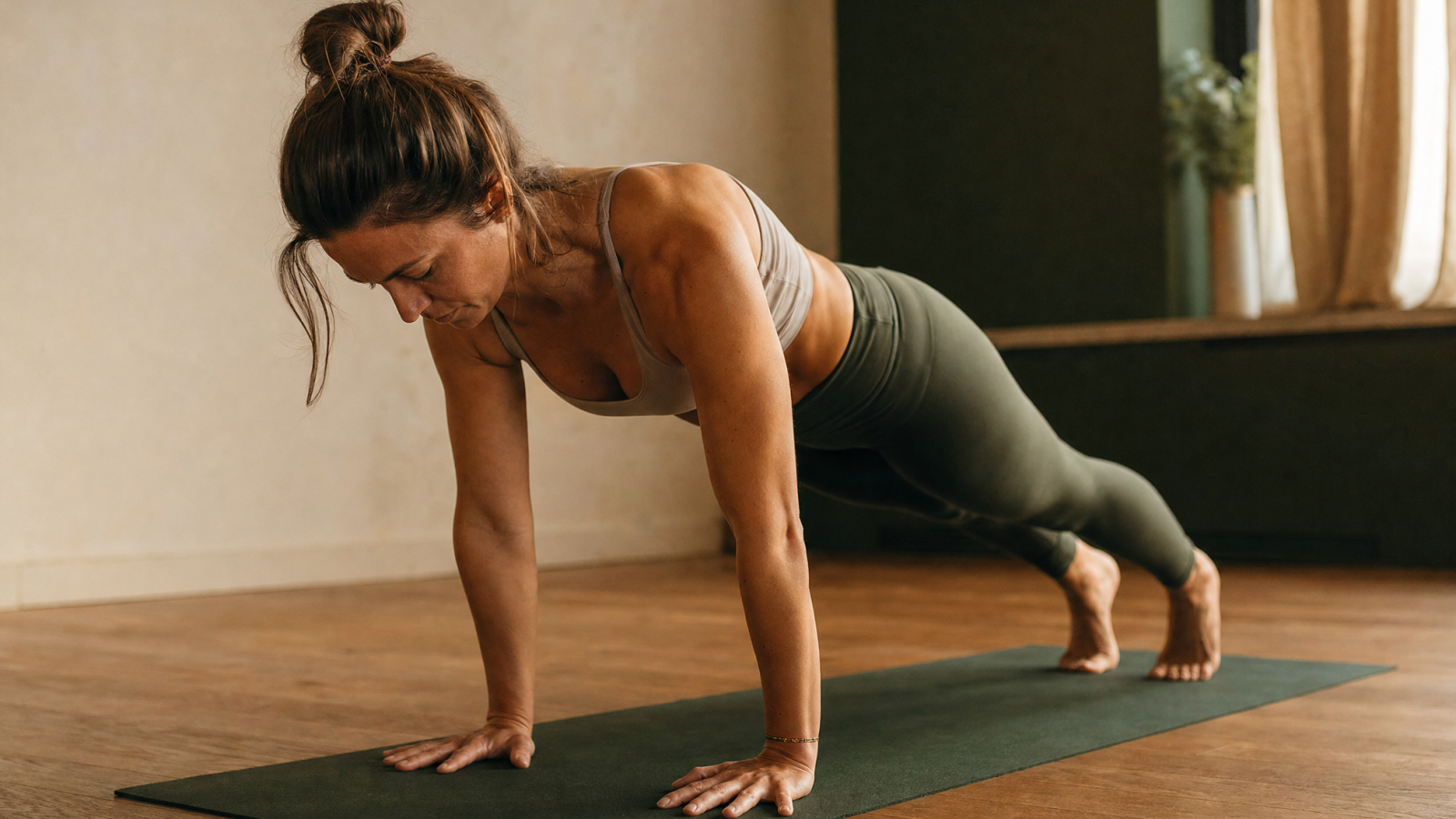
Plank is the one everyone loves to hate. It looks simple — hold a straight line, don’t collapse — but holding good form for even 30 seconds asks a lot of the abdominals, the erector spinae along the spine, and the transverse abdominis that wraps around your midsection like a corset. Done properly, it strengthens the back, shoulders and core all at once, and the longer you can hold a clean plank, the more that strength compounds.
The part people get wrong is the shoulders. Under fatigue, it’s tempting to let the hips sag or the shoulders creep up toward the ears, and that’s how you end up with strain instead of strength. If you’re not sure your form is right, check yourself in a mirror or have a friend glance at your alignment from the side — it’s much easier to spot a sagging plank in someone else than in yourself.
How to do it: Lie face-down on the floor, then press up through your arms until they’re straight, keeping your body in one line from head to heels. Balance on your toes, look down rather than forward, and hold for as long as your form stays clean — even 20 good seconds beats a minute of sagging.
2. Tree Pose
Tree pose looks like the gentle one in the sequence — until you actually try it. Balancing your full weight on one leg recruits the standing leg, the thigh, the back and the shoulders far more than it looks like it should from the outside, and it does wonders for posture over time. It’s genuinely harder for beginners and for anyone carrying extra weight, simply because balance gets tougher the more mass you’re stabilising — so don’t be discouraged if it takes practice.
How to do it: Stand tall with your shoulders relaxed and wide. Inhale and reach your arms straight overhead, then shift your weight onto one leg and lift the other, pressing the sole of your raised foot against your standing leg (avoid the knee joint itself). Hold, breathe, then switch sides.
3. Cobra Pose
Cobra is deceptively demanding. It looks like you’re just lifting your chest, but a proper cobra pulls in the entire back line and much of the abdomen too, which is exactly why it’s so often recommended for easing lower back pain — it strengthens the muscles that support the spine rather than just stretching them.
The most common mistake is turning it into an arm exercise: pressing hard through straight arms and using the palms to shove the chest up, while the back muscles do almost nothing. Keep a soft bend in the elbows and actively engage your back to lift, rather than pushing yourself up with your hands.
How to do it: Lie face-down with your hands under your shoulders and the tops of your feet pressing into the floor. Keeping your pubic bone anchored down, inhale and lift your chest, using your back muscles more than your arms. Hold for 20–30 seconds, breathing steadily, then lower back down with control.
4. Boat Pose
Boat pose is a compound move — it asks several muscle groups to work together at once, which is part of why it’s so effective. It targets the abdominals directly, but it also demands real coordination between your torso and thighs to keep the balance point steady.
There’s a gentler variation worth knowing if the full pose is too much at first: lower onto your back with your shoulders and heels hovering just off the floor (sometimes called “low boat”), which still works the same muscles with less balance demand. As a side benefit, this whole family of poses tends to aid digestion, which is one reason it’s often paired with poses aimed at reducing bloating.
How to do it: Sit with your legs extended in front of you. Lean back slightly and lift your legs until your shins are roughly parallel to the floor, then extend your legs further so they’re straight and parallel to the ground, balancing on your sit bones. Hold for about 20 seconds.
5. Chair Pose
If you’re newer to yoga, chair pose is a good place to start — it’s approachable, but don’t mistake that for easy. It works the legs and glutes hard, and the longer you hold it, the more it tests you. Over time it also helps improve posture and tones the muscles along the back and legs.
The key technical point is alignment through the knees during the half-squat: let your knees collapse inward or drift too far forward and you lose the structural support that makes the pose safe and effective.
How to do it: Stand with your feet hip-width apart, then reach your arms straight overhead, roughly in line with your ears. Bend your knees as if sitting into a chair, keeping your thighs and shins as close to parallel as your body allows, then rise back up and repeat.
6. Warrior Pose
Named for Virabhadra, a warrior figure from Hindu mythology (hence its Sanskrit name, Virabhadrasana), this is one of the more complete strength poses on this list — it works the legs, core, arms and back all together. Good foot alignment and a steady core matter here as much as the arm position, because most of the load lands on the front thigh, with a secondary pull through the biceps and deltoids as you hold your arms out.
How to do it: From standing, step your left leg back and bend your right knee in front of you, keeping your back leg strong and straight. Raise both arms to shoulder height, one reaching forward and one back, and hold for 20–30 seconds before switching sides.
7. Downward-Facing Dog
Downward dog gets used as a “reset” pose between others, but it’s doing real work on its own — strengthening the wrists, hands, lower back and hamstrings, while also easing tension through the shoulder girdle. Many people find it genuinely helps with tension headaches, likely because of how it lengthens the neck and cervical spine.
How to do it: Start standing with your feet hip-width apart, then hinge forward into an inverted V-shape, pressing your hands into the floor and your hips up and back. Keep a slight bend in the knees if your hamstrings are tight, and hold for 20–30 seconds, breathing evenly, before releasing.
8. Side Plank
Side plank takes the core demand of a regular plank and adds a balance and shoulder-stability challenge on top. Because your bodyweight rests through one arm and wrist, it builds real strength there as well as through the obliques, and it’s a genuinely good pose for lower back resilience.
How to do it: Lie on your side with your knees bent and prop yourself up on your forearm, elbow under your shoulder. Lift your hips off the floor so your body forms a diagonal line, hold for 6–8 seconds to start, then repeat on the other side.
9. Cat Pose
Cat pose (usually practised as part of the Cat–Cow flow) is less about building visible muscle and more about the connective tissue and spinal mobility that everything else depends on. It’s a quiet pose, but it plays a real role in overall stability and body awareness.
How to do it: Come onto your hands and knees in a tabletop position. Relax your shoulders away from your ears, then exhale as you round your spine toward the ceiling, tucking your tailbone and drawing your pubic bone forward. Return to neutral and repeat slowly, matching the movement to your breath.
Frequently asked questions
Can yoga strengthen muscles?
Yes. Because it’s a bodyweight practice, the poses above load the same muscle groups a gym routine would, just without external weight.
Which yoga poses build strength fastest?
Warrior pose and chair pose are two of the most efficient — both put sustained load through large muscle groups in the legs and core.
What are three good poses to start with?
Tree pose, cat pose and downward-facing dog are a solid, low-risk entry point if you’re newer to a strength-focused practice.
Which style of yoga is best for building muscle overall?
A flowing sun salutation sequence combined with warrior pose variations covers most major muscle groups in one practice.
Putting it together
None of these nine poses will replace a barbell if serious muscle mass is the goal — but that was never really the comparison. Practised consistently, they build genuine strength through the core, back, shoulders and legs, while also giving you balance and flexibility that a weights-only routine typically doesn’t. Start with two or three that feel manageable, get the form right before you chase longer holds, and build from there.


