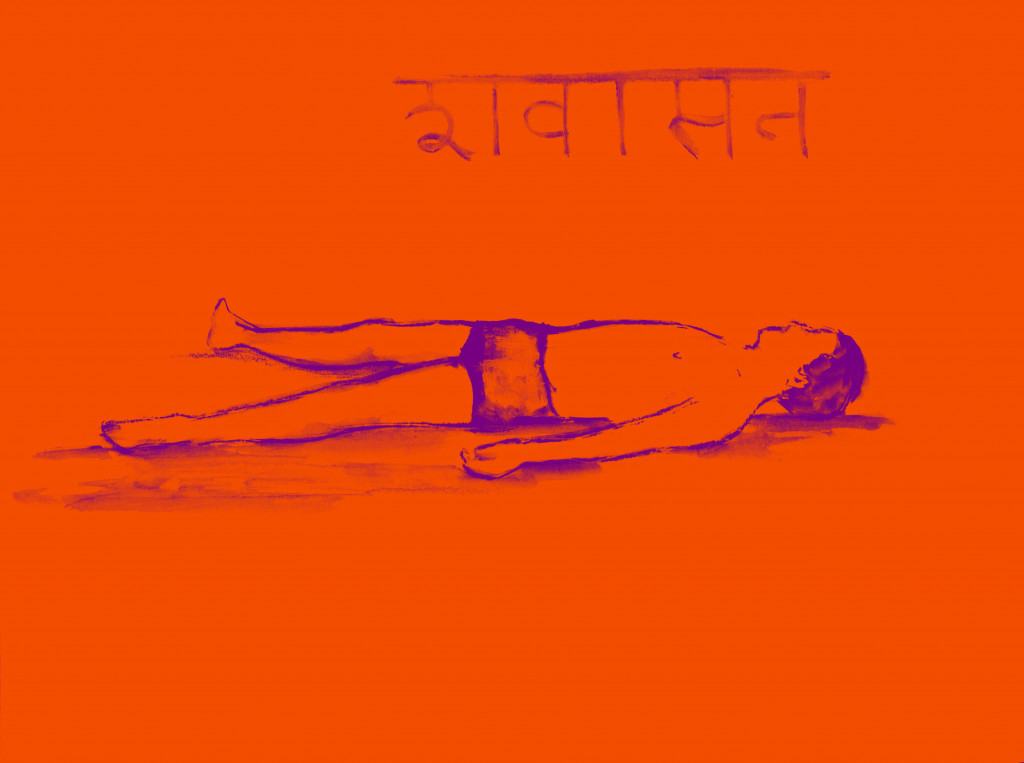
People sometimes say Savasana is the hardest yoga pose. At first, this sounds ridiculous. After bending, balancing, twisting, holding, breathing, and pulling on rebellious sinew for nearly an hour, how can lying flat on our backs be the difficult part?
In Savasana, we finally stop. No more standing poses. No more alignment cues. No more searching for the drishti. No more wondering where to put the hand, foot, hip, or shoulder. But just lie down, and find out why Savasana is difficult.
One of yoga’s central aims is learning to quiet the fluctuations of the mind, the restless movement known in the Yoga Sutras as yoga-citta-vṛtti-niroda. In a public yoga practice, we move and breathe in a sequence designed to engage body and attention. If the class lasts one hour, perhaps fifty-five minutes are occupied by doing.
The teacher speaks.
“Lift the heart, push your hips forward.”
“Follow your breath.”
“Square the hips.”
“Where is your gaze?”
Our minds are occupied with the immediate demands of practice. We may wander for a moment, but we quickly discover that we have missed an instruction or fallen out of rhythm with the gathered yogis around us. Attention returns because the practice requires it.
When the Instructions Stop
Then comes Savasana.
Directions disappear. Nobody speaks of what comes next. There is no posture to accomplish and no transition to anticipate. The body is still, and the mind, suddenly deprived of its steady stream of instructions, begins searching for new input.
What am I doing after class?
Did I answer that message?
Why did I say that yesterday?
I need to remember to buy groceries.
How much longer are we lying here?
The “monkey-mind,” finally free and released into the trees, jumps from idea-branch to concept-branch. The mind is not still, and this is why instructions from Savasana to calm the fluctuation of the mind is hard. In a world of “doing,” it’s hard to just be still with oneself.
The golden qualities we seek in yoga, stillness and equanimity, become harder to touch precisely because there is nothing left to occupy us. We are on our backs. The mind has nowhere it is required to go, so it races toward yesterday, tomorrow, unfinished business, old conversations, imagined futures.
The instruction is to lie as if dead, unmoving, and just like a corpse, except for breath.
The mind responds by making a list.
For years, I thought I knew Savasana because I did it regularly. But I am no longer certain I was practicing Savasana. We give close attention to entering our asanas. We prepare the body. We follow the breath. We establish our base, adjust, and move with intention. At the beginning of class, we may meditate, practice prāṇāyāma, establish a saṅkalpa, or dedicate our practice.
But how do we enter not the posture of Savasana, that is easy, but the atmosphere of Savasana.
Freedom to Release Yourself
I began thinking about this after a teacher ended a class session with a simple instruction:
“Release yourself into Savasana.”
I had heard “Take your Savasana” hundreds of times.
But ‘release yourself into Savasana’ was different.
Up to that point, I had been engaged mentally and physically in the moving meditation of asana. I monitored my alignment. I watched my breathing. I measured effort against fatigue. Sometimes I fell into the old ego trap and wondered how I was doing. Then I criticized myself for wondering about this which is the ego performing one of its cleverest tricks: becoming self-important about overcoming self-importance. It’s been called self-righteousness.
Release yourself.
The words interrupted the wrestling. There’s nothing fancy or righteous about releasing the self. To release is, in fact about loosening the grip and giving up control.
The Open Hand
The more I contemplate Savasana, the more I realize I’m guilty of holding on tightly to life and the way I want to be. This is not unusual, as it’s common to speak of “getting a grip” on oneself or one’s life, but somewhere along the way, a grip can become a stranglehold. We grip schedules, identities, reputations, disappointments, ambitions, people, and plans.
Savasana invites me to loosen my grip, to stop mentally leaping from branch to branch. And when the inner fist softens, when the hand that has carried the day unclenches and no longer insists on holding every demand at once, it is then possible to open and relinquish all that other stuff.
This may explain why the Sanskrit name carries such force. Śavāsana, corpse pose, does not offer a particularly sentimental image. The corpse is finished with ambition. It has no schedule. It is not moving, not jumping from thing to thing, not improving its résumé, counting followers, answering messages, or rehearsing an argument.
In yoga Savasana, we practice the radical humility of having nothing to accomplish. This is hard.
A Cloud of Witnesses
I bring theological training into my yoga practice, and occasionally an image from my earlier life returns in a new form. One such image is the scriptural description of being surrounded by a “great cloud of witnesses.”
Today, the cloud usually means digital storage. Traditionally, it meant condensed water vapor, white or grey, continually forming and reforming. But on my yoga mat, I imagine another cloud, a cloud made of people.
I practiced for years in a studio in Hawaii with approximately 200 members. I knew about 100 of them by name. I worked at remembering those names because a name gives shape to what might otherwise remain an amorphous crowd.
I knew these people by their effort.
I saw them sweat.
I saw them return.
I saw them stand, bend, fall out of balance, begin again, and finally lie down in Savasana. We became witnesses to one another’s practice, a cloud of friends, and for a moment, yoga’s solitary practice was revealed as communal.
Perhaps this is another hidden dimension of Savasana. In movement, I am aware of the yogis around me. In stillness, I can release the need to distinguish my effort from theirs. The sounds of breathing soften. The teacher’s voice disappears. Music, if there is music, seems to move farther away and the boundaries loosen.
This does not require mystical exaggeration. It may last only seconds. The mind will probably jump again. Mine does. I may return to the grocery list before the teacher says Namaste.
Again and Again
But the purpose of practice is not to become permanently empty of thought but to to notice the grip and soften it, to still the fluctuations of the mind.
Again.
And again.
And again.
Savasana becomes a practice of vairāgya, non-grasping, even if we experience it imperfectly. We allow the earth to hold the body. We relinquish the constant instruction to improve ourselves. The hand that has been gripping the day slowly opens. We stop performing yoga and receive the residue of practice.
Release yourself into Savasana . . . I still hear those words.
They remind me that Savasana is not what happens when yoga class is over. It may be the moment when we finally discover what the previous fifty-five minutes were preparing us to do.
The body grows still.
The instructions cease.
The mind comes crashing in.
And there, surrounded by our cloud of witnesses, we begin the difficult and beautiful work of opening the hand.
For one breath.
Then another.
Namaste.
Gregory A. Ormson is a writer, yoga teacher, and author of Yoga Song: Journey into Your Humanity. His yoga journey has taken him from the American Midwest to Hawai‘i, India, and the Arizona desert, where he has practiced and taught yoga as a discipline of attention, self-integration, and release. In 2017 he established Yoga and Leather, bringing yoga to people whose lives and identities do not always fit traditional yoga spaces. A former pastor and college teacher, Gregory is a bhakti musician and regularly publishes on yoga, spirituality, the body, and the difficult work of becoming fully present to our lives. His work has appeared in OM Yoga Magazine, Asana International Yoga Journal, Yoga International and other literary publications. He lives and teaches in Arizona. Connect with him @motorcyclingyogig, Facebook Gregory A Ormson, or GregoryOrmson.com.